

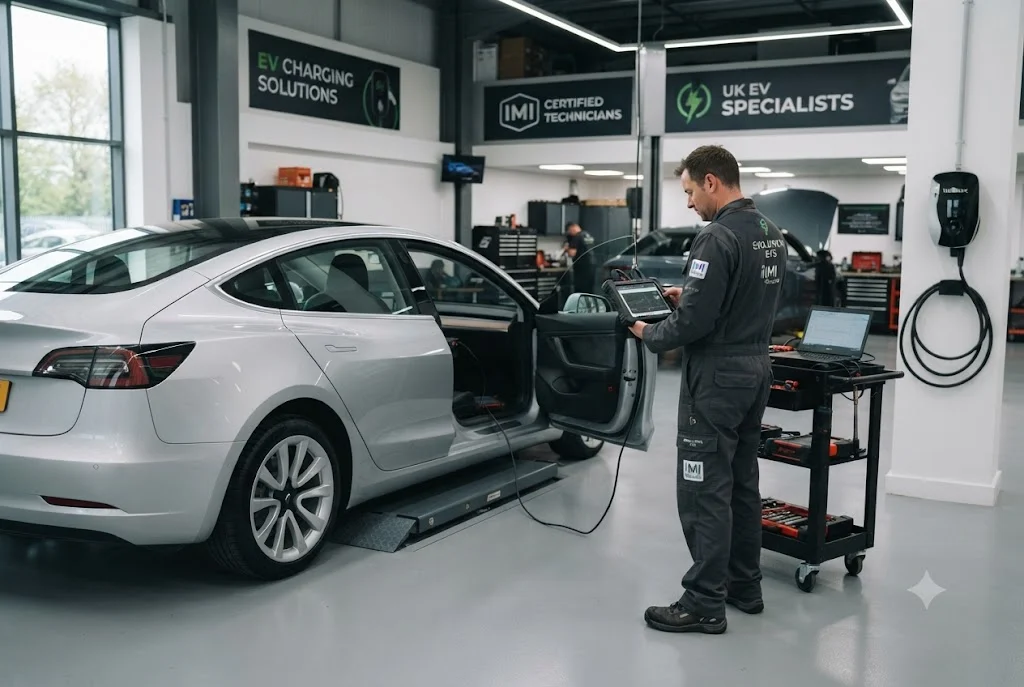
EV servicing is an important part of electric car ownership, even though battery-electric vehicles generally have fewer moving mechanical parts than conventional petrol or diesel cars. Electric vehicles still require inspections, software checks, tyre maintenance, brake checks and attention to their battery and electrical systems. Understanding electric vehicle maintenance can help UK drivers choose suitable EV garages, look after their cars properly and make everyday electric driving more straightforward.
What Is EV Servicing?
EV servicing involves inspecting and maintaining an electric vehicle according to the manufacturer’s recommended schedule. Unlike a conventional car, a fully electric vehicle does not have a petrol or diesel engine, engine oil or many of the mechanical components associated with an internal combustion engine.
However, an EV still has tyres, brakes, steering, suspension, lights, cooling systems and other components that require regular attention. It also has high-voltage electrical equipment and a traction battery that need appropriate technical knowledge when inspected or repaired.
The exact servicing requirements vary between manufacturers and models. Some electric vehicles use scheduled inspections, while others may display service requirements through the vehicle’s onboard system.
Why EV Servicing Still Matters
It can be tempting to assume that an electric vehicle needs very little maintenance. While EVs can reduce the number of routine mechanical jobs required, they are not maintenance-free.
Regular inspections can identify worn tyres, damaged suspension components, brake problems or other issues before they become more serious. They can also provide an opportunity to check systems that are specific to electric vehicles.
Following the manufacturer’s maintenance recommendations is particularly important because service schedules can differ significantly between EV models.
What Is Checked During EV Servicing?
There is no single universal EV service. A technician will normally follow the manufacturer’s requirements for the particular vehicle.
Depending on the model and service interval, checks may include:
- Tyres and tyre pressures
- Brake discs, pads and related components
- Steering and suspension
- Lights and visibility equipment
- Cabin or pollen filters
- Cooling-system components
- Charging equipment and connections
- High-voltage system checks
- Diagnostic and software checks
- Battery-related inspections
- General vehicle safety checks
Not every item will be inspected or replaced during every service. The correct schedule depends on the manufacturer’s instructions and the vehicle’s age, mileage and condition.
Electric Vehicle Maintenance vs Conventional Car Maintenance
The biggest difference is the absence of an internal combustion engine. A battery-electric car does not need engine oil changes, spark plug replacement or many of the other engine-related services required by petrol and diesel vehicles.
There are also fewer mechanical components involved in transmitting power to the wheels. An electric motor can have a much simpler mechanical arrangement than a conventional engine and gearbox combination.
However, the reduced mechanical complexity does not mean that every maintenance cost disappears. Tyres can still wear, suspension components can deteriorate, brake systems need inspection and the vehicle’s battery and electrical systems require specialist knowledge.
This is why EV servicing should be viewed as different rather than simply cheaper or unnecessary.
EV Brakes Need Attention Too
Electric vehicles often use regenerative braking. When the driver slows down, the electric motor can act as a generator and recover some energy for the battery.
Because regenerative braking can reduce the use of conventional friction brakes, some EVs may experience different brake-wear patterns compared with petrol or diesel vehicles.
That does not mean the brakes can be ignored. Brake discs, pads and other components still need inspection, particularly because components that are used less frequently can be affected by corrosion or other issues.
Drivers should have unusual noises, vibrations or changes in braking behaviour investigated promptly.
Battery Maintenance and EV Ownership
The traction battery is one of the most important and expensive systems in an electric vehicle. It stores the energy used to power the electric motor and has a significant influence on the vehicle’s range.
Modern EV battery systems are designed with sophisticated battery-management and thermal-management technology. Owners normally do not need to carry out routine battery maintenance themselves.
Instead, battery health is managed through the vehicle’s electronic systems and manufacturer-recommended maintenance procedures. If the vehicle displays a battery warning or unusual charging behaviour, it should be assessed by a suitably qualified technician.
It is also worth remembering that battery performance can vary with temperature, driving conditions, vehicle age and charging habits. A temporary reduction in range does not necessarily indicate a battery fault.
How Charging Habits Fit Into EV Maintenance
Charging is part of everyday EV ownership, even though it is not normally considered a traditional servicing task.
Drivers should follow the charging recommendations supplied by the vehicle manufacturer. Different models have different battery-management systems, charging capabilities and recommended practices.
For everyday driving, many owners use home charging where available and rely on public charging when travelling longer distances. Planning charging around normal journeys can make EV ownership considerably easier.
Drivers should also inspect charging cables and connectors for visible damage. Damaged equipment should not be used until it has been assessed appropriately.
Choosing the Right EV Garage
Not every general garage is equipped to handle every type of electric vehicle work. Routine jobs such as tyres or some conventional mechanical inspections may be available at many workshops, but high-voltage electrical work requires suitable training, equipment and safety procedures.
Before booking an EV service, ask whether the garage regularly works on electric vehicles. It is also worth asking whether technicians have relevant EV or high-voltage training and whether the workshop can access the diagnostic equipment required for your model.
A garage should be able to explain which services it can perform and which jobs may need to be referred to a manufacturer or specialist facility.
When comparing potential workshops, our garage reviews guide can help you assess customer feedback, service quality and the differences between national chains, local garages and independent workshops.
EV Mechanics and High-Voltage Systems
High-voltage systems are one of the main reasons EV servicing should be approached differently from conventional vehicle maintenance.
Electric vehicles can contain high-voltage batteries, cables, inverters and other electrical components. These systems require appropriate safety procedures and trained personnel.
Owners should not attempt to repair or dismantle high-voltage components themselves. Even when an issue appears straightforward, electrical systems can present serious hazards when handled incorrectly.
Instead, use a suitably trained EV mechanic or an authorised repair facility for work involving the high-voltage system.
Tyres Are Particularly Important for EVs
Tyres deserve regular attention on any vehicle, but electric cars can place different demands on them. EVs can be relatively heavy because of their traction batteries, while instant electric torque can influence tyre wear depending on driving style and vehicle design.
Correct tyre pressure remains essential for handling, efficiency and tyre life. Drivers should follow the manufacturer’s recommended pressures and inspect tyres regularly for uneven wear or damage.
If you notice uneven tread wear, steering pull or an off-centre steering wheel, arrange an inspection. Problems with wheel geometry can affect tyre life and driving behaviour, which is why our wheel alignment guide is useful for understanding common alignment symptoms.
EV Servicing and Software Updates
Modern electric vehicles depend heavily on software. Electronic control systems manage areas such as charging, battery operation, driver assistance and vehicle settings.
Manufacturers may release software updates to improve functionality, address issues or introduce changes to vehicle systems. The way updates are delivered varies between manufacturers and models.
Software updates are not necessarily a substitute for physical servicing. A vehicle may be running the latest software while still requiring tyre, brake, suspension or other maintenance checks.
How Often Does an EV Need Servicing?
The correct interval depends on the vehicle. Some manufacturers specify annual inspections, while others use mileage-based or condition-based schedules.
Always consult the owner’s handbook or manufacturer’s official maintenance information for the appropriate interval.
Even when an EV has a relatively long service interval, drivers should not wait for the next scheduled service if a warning light, unusual noise, charging issue or handling problem appears.
EV Servicing Costs in the UK
EV servicing costs vary significantly depending on the manufacturer, model, garage and work required. Routine servicing can involve fewer consumables than a comparable petrol or diesel vehicle because there is no engine oil or conventional engine maintenance.
However, specialist diagnostics or repairs involving high-voltage components can require trained technicians and appropriate equipment. Tyres and suspension components can also remain significant maintenance costs.
When comparing quotes, ask exactly what the service includes. A cheaper inspection may not offer the same checks as a manufacturer’s scheduled service.
What EV Owners Should Check Between Services
Routine servicing does not remove the need for everyday vehicle checks. EV owners should pay attention to several basic areas between appointments.
- Check tyre pressures regularly.
- Inspect tyres for damage and uneven wear.
- Keep charging cables and connectors in good condition.
- Pay attention to warning messages.
- Check lights and windscreen visibility.
- Listen for unusual brake or suspension noises.
- Monitor changes in charging behaviour.
- Follow the manufacturer’s maintenance recommendations.
These simple checks can help identify problems early and support safer everyday driving.
EV Ownership and Long-Distance Travel
Electric vehicle ownership can work particularly well when drivers understand their regular journeys and charging options.
For longer trips, planning charging stops can reduce unnecessary delays. Drivers should consider the vehicle’s usable range, weather conditions, traffic, driving speed and available charging locations.
It is sensible to leave a reasonable battery reserve rather than planning a journey around the vehicle reaching an extremely low state of charge at its destination.
Public charging infrastructure continues to develop, but availability can vary by location and network. Checking charging options before an unfamiliar journey can make the experience more predictable.
EV Servicing for Used Electric Cars
Buying a used EV requires more than checking its exterior condition. Prospective buyers should consider service history, battery-related information where available, charging equipment, tyre condition and the vehicle’s overall maintenance record.
Ask whether the car has been serviced according to the manufacturer’s schedule. Review previous invoices and check for unresolved warning messages.
A pre-purchase inspection by a suitably qualified EV specialist can also provide additional reassurance, particularly when buying an older or higher-mileage electric vehicle.
When to Contact an EV Specialist
Some symptoms should not be ignored. Contact an appropriately qualified EV garage if the vehicle develops unusual charging behaviour, persistent warning messages, unexpected loss of performance, electrical faults or other symptoms that may involve the high-voltage system.
Do not attempt to remove battery covers, disconnect high-voltage components or investigate electrical faults yourself unless you have the appropriate professional training.
EV Servicing and Hybrid Maintenance
Electric vehicles and hybrids share some technologies, but their maintenance requirements are different. A hybrid still contains an internal combustion engine, whereas a fully electric vehicle relies entirely on its battery and electric drivetrain for propulsion.
If you are considering both types of vehicle, our hybrid servicing guide explains how hybrid maintenance differs and what owners should consider when choosing a suitable garage.
Understanding the distinction can help drivers avoid booking the wrong type of service or assuming that experience with one type of electrified vehicle automatically means expertise with another.
How to Find Reliable EV Garages
When searching for EV garages, consider more than proximity. A garage’s ability to work safely on your particular vehicle is more important than saving a few minutes of travel.
Look for evidence of relevant training, suitable diagnostic equipment, experience with your make and model and clear communication about the work being proposed.
Customer feedback can then provide additional context. Look specifically for reviews describing electric vehicle servicing rather than assuming reviews about tyres or conventional repairs tell you everything you need to know about EV capability.
Final Thoughts
EV servicing is different from traditional car maintenance, but electric vehicles still require regular care. Tyres, brakes, suspension, charging equipment, software and electrical systems all play important roles in keeping an EV reliable.
The best approach is to follow the manufacturer’s service schedule and choose a garage with suitable EV knowledge and high-voltage safety training. Between services, simple checks and sensible charging habits can help owners identify potential problems early.
For UK drivers, understanding these maintenance requirements makes electric vehicle ownership easier and helps ensure that the benefits of electric driving are supported by responsible long-term vehicle care.
